How Much Protein Does a Woman Really Need? The Recommendation Has Changed
How Much Protein Does a Woman Really Need? The Recommendation Has Changed
By Vanessa Manfredini | Biomedical Scientist and Future Nutritionist
Protein has become the darling of 2026, and it's not a fad: a historic change happened this year. 🥩 After seven decades with the same number, the recommendation increased. And women have an extra reason to pay attention to this. Come understand with me! 🌿
"For 70 years, the protein benchmark was set to prevent deficiency. Not for you to live well."
What Changed in 2026 📊
Since the 1950s, the classic protein recommendation was 0.8 grams per kilogram of body weight per day. In January 2026, the new U.S. Dietary Guidelines increased this range to between 1.2 and 1.6 grams per kilogram. For a 70-kilogram woman, this means going from about 56 grams per day to between 84 and 112. That's quite a lot!
But I need to be honest: not everyone agrees ⚖️
Here's the part the internet usually hides. This new range is not consensual. The Academy of Nutrition and Dietetics, for example, has not adopted these numbers and maintains more conservative recommendations. And there's another important detail: these are American guidelines, not Brazilian. Our Food Guide has a different philosophy, focused on real food instead of counting grams.
In other words: it's a real and important scientific movement, but still under construction. And I prefer to tell you this rather than sell you certainty. 💚
And here's what bothers me most 🚹
Historically, most protein research has been done on men. That's right. The recommendations that reached us were largely built by studying male bodies, and then applied to women as if they were the same.
Only now are studies beginning to look specifically at us, and they already indicate that needs can vary according to the cycle phase and, especially, during perimenopause and menopause. It's not being fussy: it's science catching up. 🌸
Why Protein Matters So Much for Us 🌸
🦴 Supports bones: along with calcium and vitamin D, it protects your structure.
🍽️ Provides satiety: helps curb that urge to snack all day.
🍬 Helps blood sugar: meals with protein fluctuate less.
In Practice, and Without Obsession 🍽️
Now breathe, because I don't want you with a calculator in hand at every meal. That sickens the relationship with food, and that's not what I advocate here. The gentlest way to apply this is to think per meal:
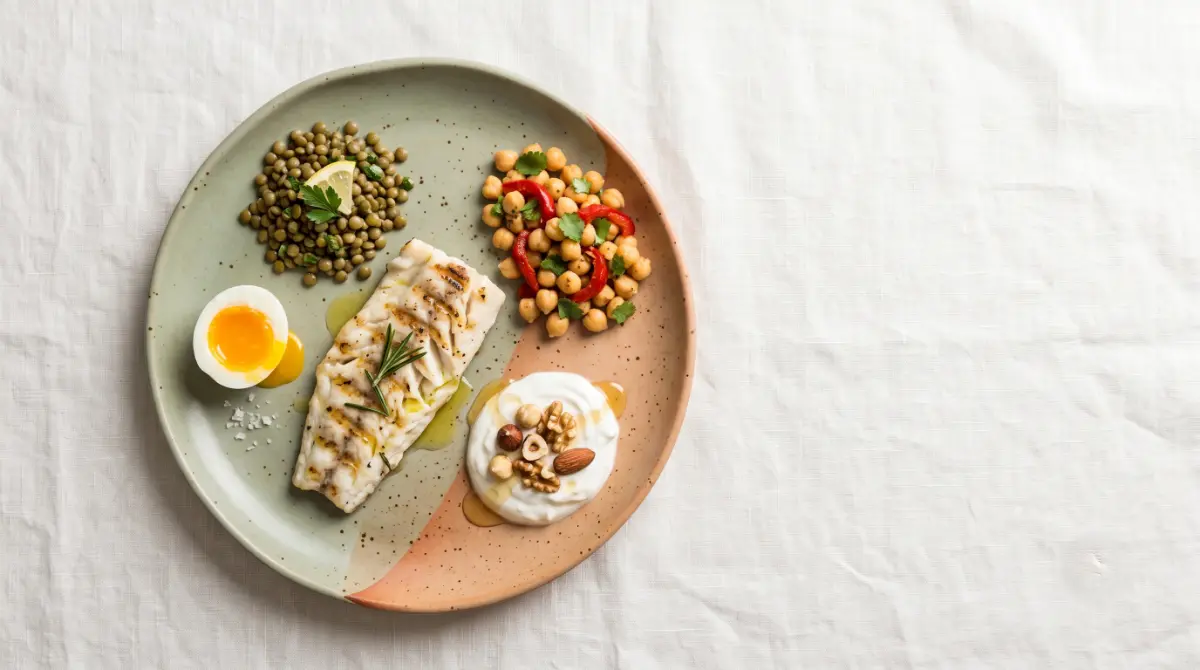
🌈 Vary your sources: eggs, fish, meats, yogurt, legumes (beans, lentils, chickpeas), tofu.
🥣 Be careful with breakfast: it tends to be the meal poorest in protein in Brazil.
🥤 Supplement is a complement: real food comes first, because it brings fiber and other nutrients with it.
"It's not about counting grams. It's about not forgetting protein."
Do you think you eat enough protein? 💚
Tell me in the comments how your breakfast is today. And share with that friend who keeps saying she "only eats a little toast in the morning"! 🌹
With care and science, Vanessa 🌹
📚 Scientific References
Content based on guidelines and literature on protein. Main references:
- Dietary Guidelines for Americans 2025-2030 (USDA and HHS), published in January 2026, which expanded the recommended protein range to 1.2 to 1.6 g/kg/day.
- Academy of Nutrition and Dietetics, which maintains more conservative recommendations, demonstrating that the topic is still subject to debate.
- Phillips SM. Current Concepts and Unresolved Questions in Dietary Protein Requirements and Supplements in Adults. Frontiers in Nutrition, 2017. DOI: 10.3389/fnut.2017.00013 (https://doi.org/10.3389/fnut.2017.00013)
- Brazilian Food Guide for the Population (Ministry of Health), which guides based on real food, not nutrient counting.
The information is for educational purposes and does not replace individualized nutritional and medical follow-up. American guidelines do not automatically apply to the Brazilian context. People with kidney disease or other conditions need specific guidance. Science is constantly evolving.