Food and Longevity: What the World's Oldest People Eat
Food and Longevity: What the World's Oldest People Eat
By Vanessa Manfredini | Biomedical Scientist and future Nutritionist
There are places in the world where reaching 100 years old is almost commonplace. 🗺️ And the question everyone asks is: what do these people eat? The answer will surprise you, because it's much simpler (and cheaper) than the longevity industry would like. Come with me! 🌿
"The greatest longevity superfood is probably already on your plate every day."
The so-called "Blue Zones" 🗺️
Researchers have identified five regions where people live much longer and get sick much less: Okinawa (Japan), Sardinia (Italy), Ikaria (Greece), Nicoya (Costa Rica), and Loma Linda (United States). Different places, different cultures... and curiously similar eating habits.
And the longevity champion is... beans! 🫘
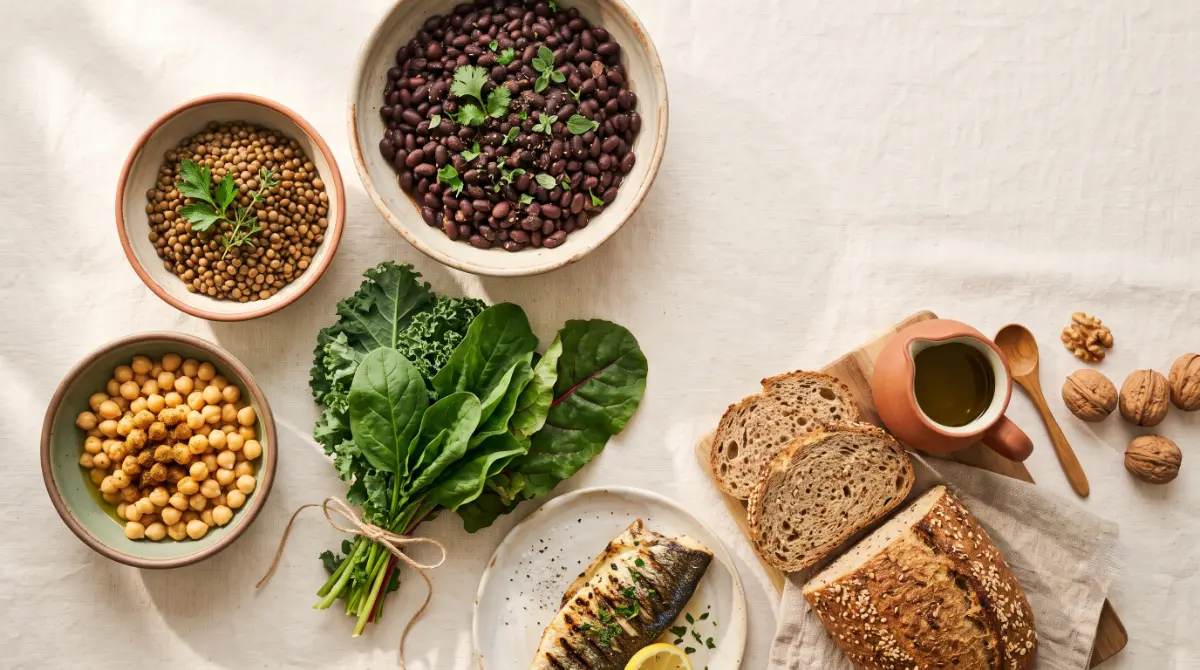
That's right. Among all foods, what is most consistently found across the five regions are legumes. Black beans in Costa Rica, chickpeas and lentils in the Mediterranean, soy in Okinawa. It's estimated they eat about a cup a day, every single day.
The rest of the menu 🥗
🌾 Whole grains: the basis of daily energy.
🥜 Nuts and seeds: a handful a day is a common habit.
🐟 Fish in moderation: less than one might imagine, a few small servings per week.
🥩 Meat rarely: usually for special occasions, not every day.
And what they DON'T eat 🚫
This part is just as important:
🍪 Packaged snacks and sweets are rare
🥓 Processed meats (cooked ham, sausage, bacon) are almost never seen
Now for the honest part: science has reservations ⚖️
Here I need to tell you what almost no one tells. As fascinating as it is, this story has serious criticisms, and they come from within.
One of the researchers who helped create the Blue Zone concept later co-authored a paper questioning the field itself. The conclusion was that the available data do not allow recommending a "Blue Zones diet" outside the context where it originated, especially with the promise of extending life.
And perhaps the secret isn't (only) on the plate 💚
This is the point that touches me most. When researchers look at these regions, they find much more than just food:
🎯 Purpose: a clear reason to get out of bed.
🧘♀️ Calming rituals: prayer, napping, a moment of pause.
👨👩👧 Connection: family nearby, decades-long friends, community.
In other words: perhaps the lesson from the Blue Zones isn't a menu, but rather a way of life. And no capsule sells that. 🌿
What you can take into your life today 🌱
🌈 More plants on your plate: you don't need to become vegetarian, it's about proportion.
🥓 Reduce processed foods: this is where the biggest gain lies.
🚶♀️ Movement in your routine: stairs, walking, cleaning. Everything counts.
💚 Cultivate people: connection is also health.
"Living long is luck. Living well is a daily construction."
Do you eat beans every day? 💚
Tell me in the comments! And share with that person who gave up beans thinking they were fattening! 🌹
With care and science, Vanessa 🌹
📚 Scientific References
Content based on literature about longevity and nutrition. Main references:
- Pes GM, Dore MP, Tsofliou F, Poulain M. Diet and longevity in the Blue Zones: A set-and-forget issue? Maturitas, 2022;164:31-37. DOI: 10.1016/j.maturitas.2022.06.004
- Blue Zones, dietary guidelines compiled from over 150 dietary surveys of the longest-lived populations.
- American Institute for Cancer Research (AICR), materials on plant-based dietary patterns and cancer risk.
- Literature on Mediterranean diet and long-term health outcomes.
The information is educational and does not replace consultation with healthcare professionals. The relationship between diet and longevity involves many factors beyond food, and population studies show associations, not direct cause and effect. Science is constantly evolving.