Is Cutting All Sugar Good for You? A Study Raised Questions
Is Cutting ALL Sugar Good for You? A Study Raised a Question
By Vanessa Manfredini | Biomedical Scientist and Future Nutritionist
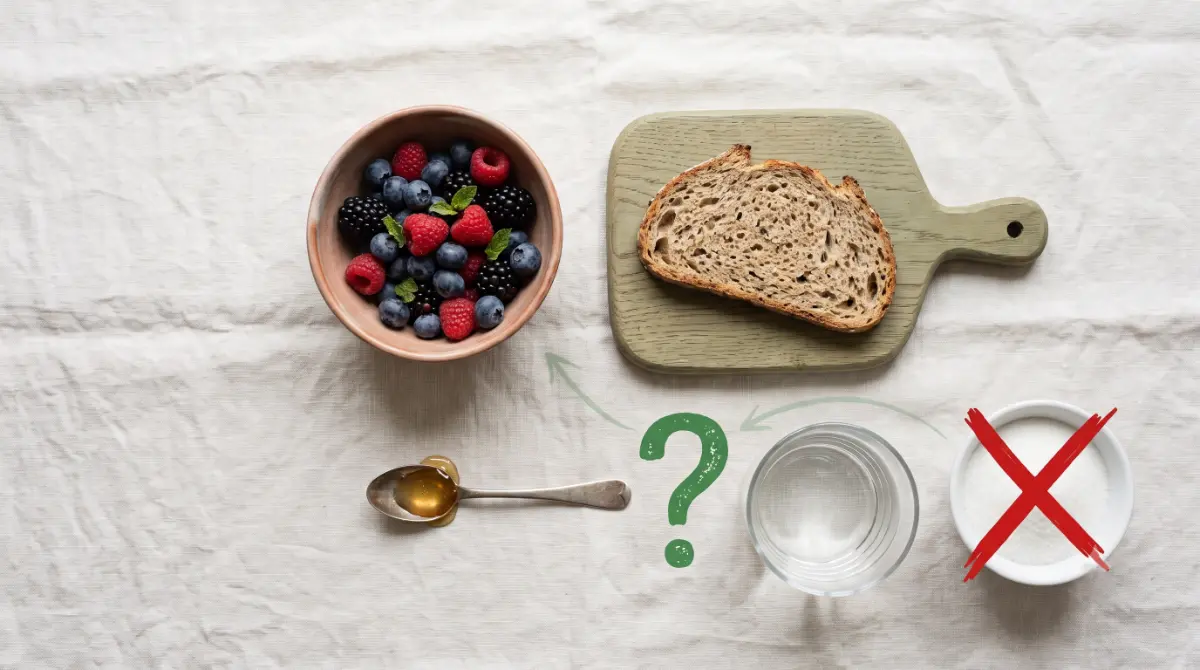
"I'm going to cut 100% of sugar from my life!" 🍬 Have you ever thought or heard this? Well, a study presented in June brought a curious twist to this story. But calm down, because this news needs context, and it's precisely this context that almost no one provides. Come with me! 🌿
"The point isn't to eat sugar. The point is that extremes are rarely the way."
What Scientists Did 🔬
Researchers from a diabetes institute in Kuwait presented their work at ENDO 2026, the annual congress of the Endocrine Society. For 16 weeks, they compared two groups of mice: one ate a low-fat diet with no sucrose (common sugar), and the other ate the same diet but with a little sucrose.
What They Found 📊
Contrary to expectations, the group that had no sugar performed worse in several aspects:
🔒 More insulin resistance
🦠 Microbiota imbalance, with a decrease in beneficial bacteria
🔥 More gut inflammation
🫀 Signs associated with fatty liver
And the most curious thing: all of this without any weight difference between the groups. 🤯
Now the most important thing: what this DOES NOT mean ⚠️
This is where I need to be very clear with you, because a headline without context can cause damage:
🐭 Mice are not people. Their metabolism and microbiota are different from ours.
📋 The study has not yet been published or peer-reviewed by other scientists. It was presented at a conference, which is an earlier stage. In other words, it's a signal, not a conclusion.
🔬 The authors themselves state that it is now necessary to investigate whether something similar happens in humans.
So why am I telling you this? 💚
Because the message the researchers left is golden, and aligns with everything I believe: balance in nutrition matters more than simply eliminating an ingredient.
Notice the subtlety. The study did not compare "a lot of sugar" with "no sugar." It compared "a little bit" with "zero." And absolute zero, in an already healthy context, brought no advantage. It brought the opposite.
What to Do with This in Real Life 🌱
🍓 Don't be afraid of natural sugars in foods: fruit is not the villain, and never has been.
🎂 A slice of cake on your birthday won't sabotage you: what sabotages is the pattern, not the exception.
💚 Be wary of "eliminate everything": the more radical the promise, the less likely it is to last.
"Real food, balance, and lightness. The rest is faddism."
Have you ever tried to cut 100% of sugar? 💚
Tell me in the comments how it went. And share with anyone who keeps trying to eliminate everything and gets frustrated along the way! 🌹
With care and science, Vanessa 🌹
📚 Scientific References
Content based on research presented at a conference. Main references:
- Ahmad R et al., Dasman Diabetes Institute (Kuwait). Animal study presented at ENDO 2026, annual congress of the Endocrine Society, Chicago, June 2026. Dissemination material available at: https://www.endocrine.org/news-and-advocacy/news-room/2026/ahmad-press-release-endo-2026
- Important: this work was presented at a conference and, as of the publication of this post, had not yet undergone peer review or been published in a scientific journal.
- Consolidated literature on reducing added sugar and metabolic health, which remains the current recommendation of health organizations.
The information is educational and does not replace consultation with health professionals. Animal studies cannot be directly transferred to humans, and conference findings are preliminary. Science is constantly evolving.