FODMAPs: The Complete Guide (and the Mistake Almost Everyone Makes)
FODMAPs: The Complete Guide (and the Mistake Almost Everyone Makes)
By Vanessa Manfredini | Biomedical Scientist and future Nutritionist
Have you ever heard of FODMAP and felt like it's just another complicated acronym? 🤔 Well, this is one of the most fascinating (and most poorly explained) topics in gut health. Today I'm going to break it all down for you, including the mistake that makes many people worse while thinking they're getting better. Come on! 🌿
"FODMAPs are not poison. They are good food that, in some guts, makes noise."
What does this acronym mean? 🔤
FODMAP is an acronym for a group of short-chain carbohydrates that the small intestine poorly absorbs. Let's go letter by letter:
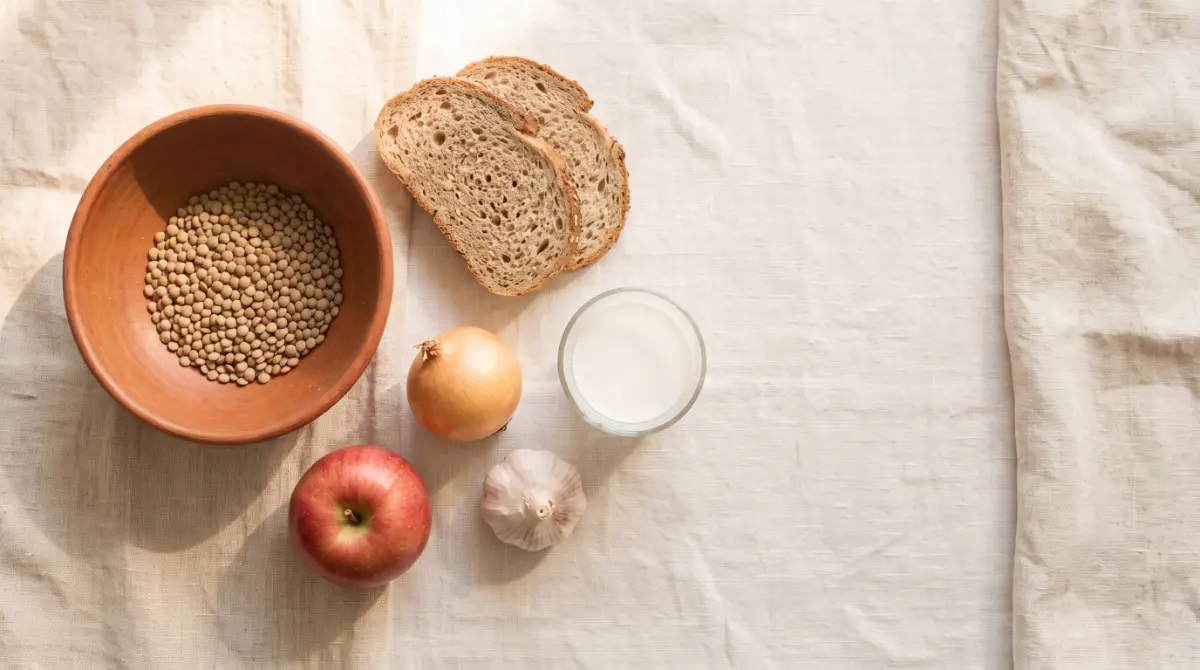
O for Oligosaccharides: fructans (wheat, onion, garlic) and galacto-oligosaccharides (beans, lentils, chickpeas).
D for Disaccharides: this is where lactose resides (milk, yogurt, fresh cheeses).
M for Monosaccharides: excess fructose (honey, mango, apple, corn syrup).
A for And: it's just the "and" in English. 😄
P for Polyols: sorbitol, mannitol, xylitol (avocado, mushroom, cauliflower, and sweeteners in "diet" products and chewing gum).
How they cause symptoms 🔬
There are two mechanisms, and understanding them changes everything:
💨 Fermentation: upon reaching the large intestine, they become a feast for bacteria. They ferment and produce gas, which causes bloating and discomfort.
And here's the part nobody explains 🧠
This happens to EVERYONE. Yes, to you, to me, to everyone. Fermentation is normal and even desirable, because that's how we feed our microbiota.
So why do only some people suffer? Because in those with sensitive guts (such as in irritable bowel syndrome), there is an increased perception of these sensations. The same volume of gas that I don't even feel can cause real pain in someone else. It's not fussiness; it's a real difference in how the gut communicates with the brain. 💚
The low FODMAP diet has THREE phases 📋
This protocol originated at Monash University in Australia and is one of the most studied approaches for irritable bowel syndrome. And here's what almost all content out there forgets to mention: it's not a diet; it's a protocol with a beginning, middle, and end.
Reduce FODMAPs for a short period, usually 2 to 6 weeks. The goal is not to lose weight or "cleanse" anything: it's to calm symptoms to allow for investigation. That's it.
This is the most important phase, and the most ignored. One group at a time returns to your plate, in increasing doses, to discover which ones truly bother you and in what quantity. Many people find they reacted to only one or two groups!
The diet opens up again, maintaining restriction only on what demonstrably causes discomfort, and at the dose that causes discomfort. The ultimate goal is the greatest possible variety with the fewest symptoms.
And now, THE MISTAKE ⚠️
Here's why I wrote this post. Most people who hear about FODMAPs do Phase 1... and stay there. Forever. They download a list from the internet, cut everything out, feel initial relief, and never reintroduce.
The problem is serious:
🥗 Impoverishes nutrition: fibers, vitamins, and minerals are lost along with it.
😔 Harms the relationship with food: the list of "forbidden" foods grows, social life shrinks, fear increases.
🔄 Can worsen in the long term: a gut with an impoverished microbiota tends to become even more sensitive.
In other words: Phase 1 without Phase 2 is half the journey, and half the journey here comes at a high cost. 💔
The dose makes the poison 🥄
Another little-discussed point: FODMAP is dose-dependent. Half a clove of garlic might pass smoothly, while three cloves cause chaos. Half a slice of avocado might be okay, but a whole avocado might not. That's why "do and don't" lists on the internet are so problematic: they ignore the quantity, which is precisely what matters.
Is this for you? 🤔
❌ Does NOT make sense for: those who want to lose weight, who have occasional and normal gas, who just want to "de-bloat," or who want to test it out of curiosity.
"The goal was never to cut out food. It was to discover what your gut needs."
Did this guide clarify things? 💚
Tell me in the comments: had you heard of FODMAPs before? Save this post and share it with anyone who is cutting out foods on their own. This information can save a lot of suffering! 🌹
With care and science, Vanessa 🌹
📚 Scientific References
Content based on literature about FODMAPs and digestive health. Main references:
- Monash University (Australia), the institution where the low FODMAP concept and protocol were developed, and which maintains the research and education program on the topic.
- Gibson PR, Shepherd SJ. Evidence-based dietary management of functional gastrointestinal symptoms: the FODMAP approach. Journal of Gastroenterology and Hepatology, 2010.
- Literature on the reduction of beneficial bacteria, including bifidobacteria, associated with prolonged FODMAP restriction, reinforcing the temporary nature of the restriction phase.
- Guidelines from gastroenterology and nutrition societies on the management of irritable bowel syndrome, which recommend the three-phase protocol with professional supervision.
The information is for educational purposes and does not replace diagnosis and follow-up with a doctor and nutritionist. FODMAP restriction without guidance can cause nutritional and microbiota damage. Science is constantly evolving.