Do Beans Give You Gas? Don't Cut Them Out, Do This First
Do Beans Give You Gas? Don't Cut Them Out, Do This First
By Vanessa Manfredini | Biomedical Scientist and Future Nutritionist
"I love beans, but they make me bloated, so I stopped eating them." 🫘 If this sounds like you, this post is a gentle reminder: don't cut them out! There's an explanation for this discomfort, and there's a solution. Come understand with me! 🌿
"Gas isn't a sign that food is bad for you. Sometimes it's a sign that it's doing good."
Why do beans cause gas? 💨
Beans (and legumes in general) contain special carbohydrates called oligosaccharides, which our small intestine cannot break down. They are not absorbed and travel to the large intestine, where your bacteria have a feast: they ferment these carbohydrates. And fermentation produces gas. It's that simple.
In other words: it's not intolerance 💚
This is the point that changes everything. Feeling a little gas with beans is physiological; it's not a disease or an intolerance. Many people cut out legumes thinking they "do harm," when in reality, the gut just needs two things: proper food preparation and time to adapt.
What to do in practice 🥄
Here are the strategies that truly make a difference:
♨️ Cook thoroughly: a pressure cooker is your friend. Hard beans ferment more.
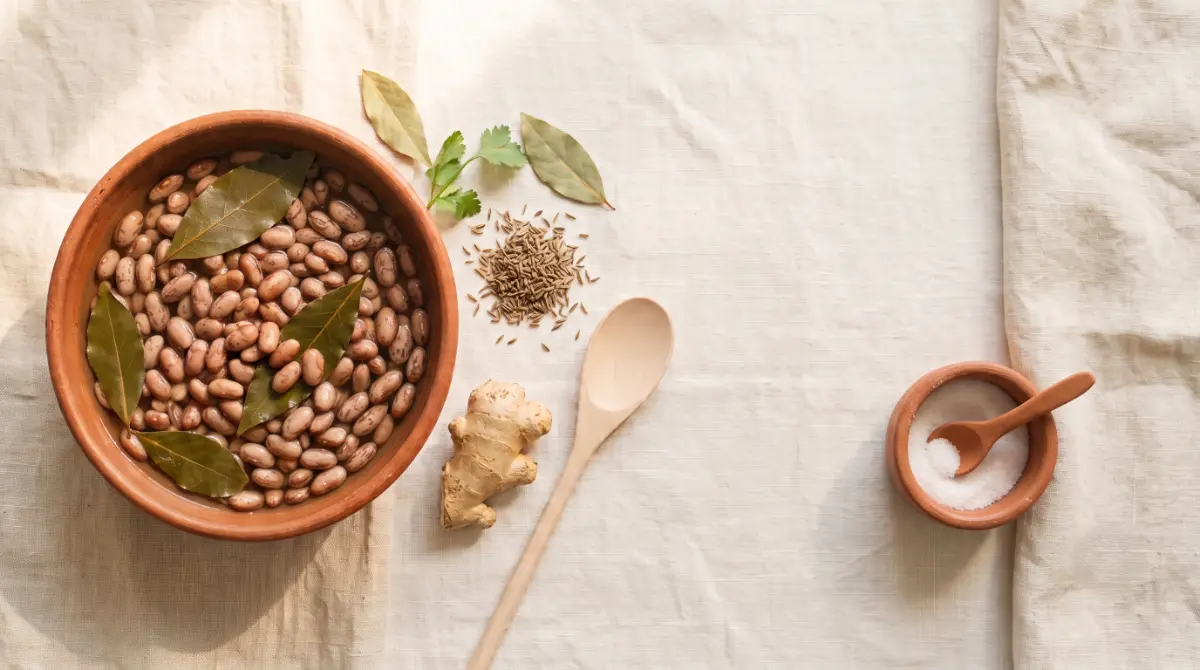
🌿 Use carminative spices: bay leaf, cumin, fennel, and ginger help with gas. And it's not an old wives' tale: it's traditional use that science is studying.
📈 Start with a little: two spoonfuls a day are enough. The microbiota adapts in a few weeks.
🫛 Try lighter options: lentils and peas are usually more friendly at first.
🍽️ Chew slowly: eating fast makes you swallow air, which also causes bloating.
The part almost no one understands 🧠
If you went years without eating beans and then suddenly returned to a full ladle, discomfort will indeed arise. Not because beans are bad, but because your microbiota is unaccustomed. It's like returning to the gym after years: the soreness doesn't mean exercise is bad; it means your body is readapting.
Give it time. It will pass. 💚
When bloating deserves attention ⚠️
Now, there's a limit. A little gas is normal. But if you:
🔴 Feel real pain, not just discomfort
🔴 Have changes in your bowel habits (alternating diarrhea and constipation)
🔴 React to several different foods
Then it's not the beans; it's your gut asking for investigation. It could be SIBO, irritable bowel syndrome, or something else. And that deserves a professional, not self-imposed food restrictions.
"Beans are not the problem. Sometimes, they are precisely the solution."
Had you cut out beans? 💚
Tell me in the comments! And share with that person who loves beans but avoids them for fear of bloating! 🌹
With care and science, Vanessa 🌹
📚 Scientific References
Content based on literature about legumes and intestinal fermentation. Main references:
- Literature on legume oligosaccharides (raffinose, stachyose, and verbascose), their non-absorption in the small intestine, and the resulting colonic fermentation.
- Studies on preparation techniques (soaking with water discard and prolonged cooking) and the reduction of fermentable oligosaccharide content.
- Literature on the adaptation of the intestinal microbiota to the gradual increase in fiber intake.
- Monash University, educational materials on FODMAPs and digestive symptoms.
The information is educational and does not replace consultation with health professionals. Persistent digestive symptoms warrant medical investigation. Science is constantly evolving.