Gut-Skin Axis: Why Your Acne and Dry Skin Might Be an Intestinal Problem
Gut-Skin Axis: Why Your Acne, Rosacea, and Dull Skin Might Originate in Your Gut
By Vanessa Manfredini | Aesthetic Biomedic and future Nutritionist
Have you used all the acids, all the serums, all the moisturizers, and still your skin doesn't improve as it should? Acne that won't clear, constantly inflamed skin, rosacea that worsens for no apparent reason, eczema that comes and goes?
Before you switch another skincare product, answer me one thing: how is your gut?
The connection between the gut and skin is not an alternative medicine concept; it's consolidated science, with research published in the world's leading medical journals. And as an Aesthetic Biomedic with a background in microbiology and nutrition, I can tell you: this is one of the most fascinating and most ignored connections in skin care.
Today I will explain what the gut-skin axis is, how the gut microbiota influences your skin health, and what you can do from the inside out to truly transform your skin.
"No serum will solve what the gut is causing. Skin care starts from within."
What is the gut-skin axis?
The gut-skin axis is the bidirectional communication between the gastrointestinal tract and the skin, mediated by the immune system, hormones, neurotransmitters, and metabolites produced by the gut microbiota.
Simply put: what happens in your gut is reflected in your skin. And what happens on your skin can signal what's happening in your gut.
This connection exists because:
- Gut and skin develop from the same embryonic tissue, the ectoderm.
- Both have their own microbial populations – the gut microbiota and the skin microbiota – which mutually influence each other.
- The intestinal immune system regulates the systemic inflammatory response that directly affects the skin.
- Metabolites produced by intestinal bacteria circulate through the blood and reach skin cells.
How gut dysbiosis affects the skin
When the gut microbiota is imbalanced, which we call dysbiosis, a series of events occur that directly impact the skin:
Increased intestinal permeability
Dysbiosis compromises the intestinal barrier, that structure we saw in the post about leaky gut. With a compromised barrier, bacterial toxins, microorganism fragments, and undigested food particles enter the bloodstream. The immune system detects these invaders and triggers a systemic inflammatory response that manifests on the skin as inflammatory acne, rosacea, eczema, and psoriasis.
Hormonal imbalance
The gut microbiota participates in the metabolism of sex hormones, especially estrogens, through the estrobolome. When this balance is disturbed, excess androgens can stimulate the sebaceous glands to produce more sebum, the main fuel for acne.
Production of inflammatory toxins
Excess pathogenic bacteria in the gut produce substances like LPS (lipopolysaccharide), which is a potent activator of systemic inflammation. This chronic low-grade inflammation manifests on the skin as redness, sensitivity, and premature aging.
Deficiency of essential skin nutrients
Dysbiosis impairs the absorption of nutrients fundamental for skin health: zinc, vitamin A, vitamin C, omega-3, collagen, and biotin. No matter how much you consume these nutrients, if the gut doesn't absorb them properly, the skin won't receive what it needs.
"The skin is a mirror of the gut. When the microbiota is in balance, the skin tends to reflect that, and vice versa."
Skin conditions associated with gut dysbiosis
Acne
The relationship between the gut and acne is one of the most studied. Research shows that people with acne have a higher prevalence of gut dysbiosis, irritable bowel syndrome, and leaky gut. The systemic inflammation generated by dysbiosis activates TLR4 receptors on skin cells, stimulating the production of inflammatory cytokines that contribute to lesion formation.
Interesting: studies show that probiotics, especially Lactobacillus and Bifidobacterium, can reduce inflammatory acne from the inside out by modulating the cutaneous immune response.
Rosacea
Rosacea has a particularly strong association with intestinal changes. Studies show an increased prevalence of SIBO (small intestinal bacterial overgrowth) in people with rosacea. Treating SIBO significantly improves rosacea in many cases. The connection is real and documented.
Eczema and Atopic Dermatitis
Children born by C-section, who have different intestinal colonization than those born by vaginal delivery, have a higher risk of developing atopic dermatitis. The gut microbiota in the first years of life is fundamental for the maturation of the cutaneous immune system. In adults, dysbiosis can worsen eczema episodes.
Psoriasis
People with psoriasis have a significantly different intestinal microbial composition than people without the condition, with lower diversity and lower abundance of anti-inflammatory species. Microbiota interventions are being studied as a complementary approach to psoriasis treatment.
Premature aging and dull skin
Chronic low-grade inflammation generated by dysbiosis accelerates the degradation of collagen and elastin, contributing to premature wrinkles, loss of firmness, and dull skin. This is what medicine calls inflammaging (inflammatory aging).
The skin microbiota: another important ecosystem
Like the gut, the skin has its own microbiota – trillions of microorganisms that live on the skin surface and perform essential functions:
- Protection against pathogens: they occupy space and resources, preventing colonization by harmful bacteria.
- Regulation of skin pH: maintaining the skin's protective acid mantle.
- Modulation of the cutaneous immune response.
- Production of natural antimicrobial substances.
Excessive use of aggressive products, topical antibiotics without indication, overly harsh soaps, and even excessive alcohol can unbalance the skin microbiota, just as ultra-processed foods unbalance the gut microbiota.
Candida and skin: the connection few explain
Candida is a fungus that is part of the body's normal microbiota (gut, skin, and mucous membranes). The problem arises when it proliferates excessively, which happens precisely in situations of gut dysbiosis, antibiotic use, a diet rich in sugar, and low immunity.
On the skin, excess Candida can manifest as:
- Cutaneous candidiasis - especially in skin folds.
- Skin prone to inflammation and constant itching.
- Acne that does not respond well to conventional treatments.
- Seborrheic dermatitis - dandruff and flaking.
- Sensitivity and diffuse redness.
Topical treatment resolves the symptom, but as long as the gut has an excess of Candida, the skin will continue to be affected. That's why treating dysbiosis from within is fundamental for those with fungus-related skin problems.
What diet can do for your skin
Anti-inflammatory foods: the basis of internal skincare
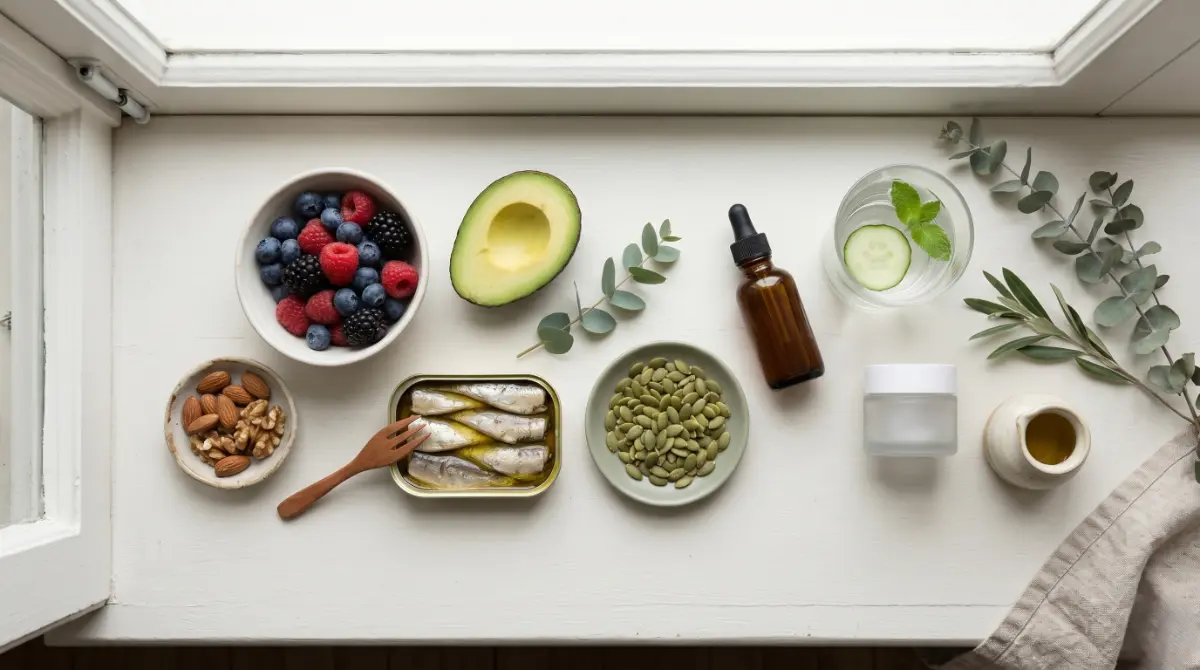
- Omega-3 - sardines, salmon, chia, flaxseed: reduces inflammation that causes acne and rosacea.
- Antioxidants - berries, cocoa, olive oil, turmeric: protect against oxidative stress that ages the skin.
- Vitamin C - acerola, guava, kiwi, bell pepper: essential for collagen synthesis.
- Zinc - pumpkin seeds, nuts, meats: regulates sebum production and has anti-inflammatory action.
- Vitamin A - liver, egg yolk, carrots, mango: fundamental for skin cell renewal.
Caring for the microbiota: internal skincare
- Probiotics - kefir, natural yogurt, curd: repopulate the gut and modulate the cutaneous immune response.
- Prebiotics - beans, oats, green banana, garlic: feed the bacteria that protect the skin.
- Reduce refined sugar - the main fuel for Candida and inflammatory bacteria.
- Reduce ultra-processed foods - emulsifiers that compromise the intestinal barrier.
- Hydration - dehydrated skin loses barrier function much more easily.
Collagen from the inside out
Collagen is the most abundant protein in the skin, responsible for firmness, elasticity, and support. To produce it, the body needs:
- Vitamin C - essential cofactor for collagen synthesis.
- Zinc and copper - minerals that activate the enzymes that form collagen.
- Amino acids - glycine, proline, and hydroxyproline, present in bone broths, gelatin, and animal proteins.
- Organic silicon - present in oats, bananas, and cucumbers.
Hydrolyzed collagen supplementation has growing evidence for improving skin elasticity and hydration, but without cofactor nutrients and a healthy gut for absorption, the effect is very limited.
External skincare + internal health: the most powerful combination
I'm not saying that external skincare doesn't work; on the contrary. Acids, serums, sunscreen, and active ingredients work. But they work much better when the body is balanced internally.
Think of it this way: you can use the best hyaluronic acid on the market, but if you're dehydrated, with an inflamed gut and high cortisol, your skin will remain dry and dull. The product cannot compensate for what internal biology is compromising.
The smartest approach is an integrated one:
- Well-formulated external skincare suitable for your skin type.
- Anti-inflammatory diet rich in skin nutrients.
- Healthy gut microbiota - the foundation of everything.
- Quality sleep - it's during sleep that the skin regenerates.
- Stress management - high cortisol worsens acne, rosacea, and eczema.
- Adequate hydration - from inside and out.
"The best skincare is one that starts on your plate, goes through your gut, and reaches your skin with everything it needs to glow."
Conclusion
The gut-skin axis is real, scientific, and transformative. Understanding that the skin is a reflection of internal health completely changes the approach to care, both for those suffering from acne and rosacea and for those who want to delay aging and have healthy skin long-term.
This doesn't mean abandoning external skincare; on the contrary. It means enhancing it with what truly makes a difference from within: a balanced microbiota, an anti-inflammatory diet, the right nutrients, and a gut that absorbs everything the skin needs. From the inside out. Always.
See the article on Intestinal Dysbiosis here.
Learn more about Microneedling here.
Did you like this content?
Leave your comment below – have you noticed any connection between your gut health and your skin? Tell me! And follow me on social media for more content on gut health, science-backed skincare, and real nutrition! 🌿
With care and science, Vanessa 🌹
This content is based on scientific studies about the gut-skin axis. Main references:
- 1. Salem I, et al. The gut microbiome as a major regulator of the gut-skin axis. Frontiers in Microbiology, 2018.
- 2. Bowe WP, Logan AC. Acne vulgaris, probiotics and the gut-brain-skin axis. Gut Pathogens, 2011.
- 3. De Pessemier B, et al. Gut-skin axis: current knowledge of the interrelationship. Microorganisms, 2021.