Gut Microbiota: What it is, what it's for, and how to care for your good bacteria
By Vanessa Manfredini | Biomedical Scientist and future Nutritionist
You carry a universe within you. Literally.
In your gut live approximately 100 trillion microorganisms — bacteria, fungi, viruses, and other microscopic beings that form what we call the gut microbiota. There are so many that they outnumber the human body's own cells.
And the most impressive part? They are not there by chance. They work for you. Or against you — depending on how you treat them.
In this post, I will explain what the microbiota is, what it does, the difference between probiotics and prebiotics, and especially which everyday Brazilian foods help keep it healthy. Because when the microbiota is doing well, much of the rest follows.
What is the gut microbiota?
The gut microbiota is the collection of microorganisms that inhabit our gastrointestinal tract, especially the large intestine. Each person has a unique microbiota — like a fingerprint — formed throughout life by factors such as:
Type of birth (vaginal or C-section)
Whether breastfed or not
Diet throughout life
Use of antibiotics and medications
Level of chronic stress
Sleep quality
Contact with nature and animals
We used to call this collection intestinal flora. Today, the correct term is microbiota because flora refers to plants, and the microorganisms in the gut are not plants. Science evolves, and so does vocabulary.
"Your microbiota is your second biological identity. No one else in the world has one exactly like yours."
What is the gut microbiota for?
The microbiota is not just there to aid digestion — although it does that very well. It is a complete functional organ, with fundamental roles in various areas of the body:
1. Immune system
About 70% of the immune system is in the gut. The microbiota trains and regulates the body's defense cells, teaching them to distinguish between enemy and ally. An unbalanced microbiota means a confused and hyperactive immune system.
2. Nutrient production
Certain gut bacteria produce vitamins that the body cannot make on its own, such as vitamin K2 and some B vitamins. They also produce short-chain fatty acids — especially butyrate, which is the main food for your gut cells.
3. Mental health — the gut-brain axis
Did you know that about 90% of your body's serotonin is produced in the gut? The microbiota directly influences the production of neurotransmitters like serotonin, dopamine, and GABA — substances that regulate mood, anxiety, and well-being.
That's why it's no coincidence that people with gut dysbiosis frequently report symptoms like anxiety, irritability, and low mood.
4. Metabolism and body weight
The composition of the microbiota influences how the body extracts energy from food, regulates body fat, and responds to insulin. Studies show that people with obesity have less microbial diversity — and that the microbiota can be both a cause and a consequence of this condition.
5. Protection against pathogens
Good bacteria occupy space and resources in the gut, making it difficult for harmful microorganisms to colonize. This is what we call colonization resistance — the microbiota as the guardian of the intestinal territory.
What happens when the microbiota becomes unbalanced?
When there is a reduction in diversity or an imbalance between microorganism species, we have gut dysbiosis. This imbalance can manifest in many varied ways:
Frequent bloating, gas, diarrhea, or constipation
Low immunity — recurring infections and slow recovery
Symptoms of anxiety and mood swings
Difficulty losing weight
Low-grade chronic inflammation
Worsening of autoimmune conditions
Reactive skin — acne, eczema, blemishes
Dysbiosis rarely appears in isolation. It is often both a cause and a consequence of other imbalances in the body — which is why it is so important to view it within a broad clinical context.
Probiotics vs. Prebiotics: Understand the difference once and for all
This is one of the most confusing points — and it makes all the difference in practice. Let's simplify:
🌱 Prebiotics — food for good bacteria
Prebiotics are fibers that our body does not digest, but which serve as food for the beneficial bacteria in the gut. Think of it this way: you don't eat for yourself, you eat for them. And when they eat well, they produce substances that protect your gut and your entire body.
A simple analogy: if good bacteria are the plants in your intestinal garden, prebiotics are the fertilizer.
Accessible prebiotic sources in Brazil:
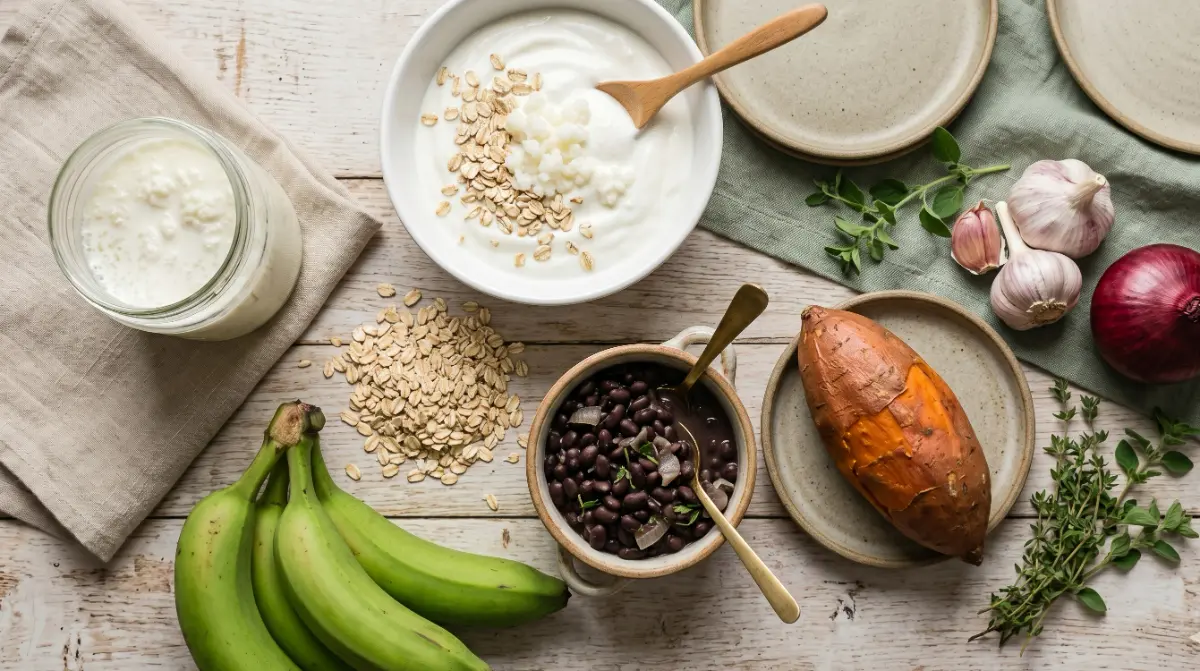
Slightly green 'banana prata' or 'nanica' — rich in resistant starch
Raw garlic and onion — sources of fructooligosaccharides (FOS)
Beans, lentils, and chickpeas — legumes rich in prebiotic fibers
Rolled oats — source of beta-glucan, one of the most studied fibers
Cooked and cooled cassava and sweet potato — cooling increases resistant starch
Green jackfruit — excellent source of prebiotic fiber and very Brazilian
Lettuce, chicory, and dandelion greens — rich in inulin
Passion fruit — the peel and white part are rich in prebiotic pectin
Brazil nut — in addition to selenium, contributes fibers to the microbiota
🦠 Probiotics — the good bacteria themselves
Probiotics are live microorganisms that, when consumed in adequate amounts, bring health benefits. Here you are not feeding the bacteria — you are introducing new bacteria into your system.
Returning to the garden analogy: if prebiotics are the fertilizer, probiotics are the new seedlings you plant.
Accessible probiotic sources in Brazil:
Unsweetened natural whole yogurt — opt for brands with live lactobacilli on the label
Milk kefir — easy to make at home, rich in microbial diversity
Water kefir — great option for those with lactose intolerance
Curdled milk ('coalhada') — naturally fermented, very common in Northern and Northeastern Brazil
Artisanal Minas Frescal cheese — contains natural lactic bacteria
Homemade sauerkraut — fermented cabbage, easy to prepare and inexpensive
Naturally fermented pickles — different from industrialized vinegar pickles
Kombucha — fermented tea, increasingly accessible in Brazil
Probiotic supplements — indicated when clinically necessary, always with professional guidance
🔄 And what is symbiotic?
Symbiotic is when you combine probiotic + prebiotic together. For example: natural yogurt with green banana and oats. You are introducing good bacteria (probiotic) and immediately giving them their food (prebiotic). It's the smartest combination to enhance the effects!
"Prebiotic feeds. Probiotic populates. Symbiotic does both at the same time."
What reduces your microbiota?
Just as important as knowing what helps is knowing what harms:
Ultra-processed foods rich in additives and emulsifiers
Excess refined sugar — favors the growth of pathogenic bacteria and fungi
Excessive alcohol
Prolonged or unnecessary use of antibiotics — eliminates both good and bad bacteria
Frequent use of anti-inflammatories
Chronic stress — directly alters microbiota composition via the gut-brain axis
Poor sleep quality — the microbiota has its own circadian rhythm
Monotonous diet poor in fiber
👀 Conclusion
The gut microbiota is one of the most fascinating and complex systems in the human body. Caring for it is not a fad; it is one of the most scientifically well-founded strategies to promote broad and lasting health.
And the good news is that you don't need expensive or imported products for this. Brazilian cuisine has incredible ingredients to nourish your microbiota: beans, bananas, cassava, curdled milk, homemade kefir. The richness is very close to you.
Every meal is an opportunity to feed the right bacteria. Every choice is a message you send to your gut — and it responds.
"Take care of your microbiota and it will take care of you. This is one of the oldest and most powerful partnerships in human biology."
Did you like this content?
Leave your comment below telling us about your gut health! And follow me on INSTAGRAM @vanessamanfredini.nutri and YOUTUBE Bio Código Saúde for daily scientific content — there's much more about microbiota and gut health waiting for you there too!
Access this content about Intestinal Dysbiosis.
With care and science, Vanessa 🌹
This content is based on scientific studies about the gut microbiota and human health. Main references:
- Valdes AM, Walter J, Segal E, Spector TD. Role of the gut microbiota in nutrition and health. BMJ, 2018.
- Sonnenburg JL, Bäckhed F. Diet-microbiota interactions as moderators of human metabolism. Nature, 2016.
- Rinninella E, et al. What is the healthy gut microbiota composition? Microorganisms, 2019.
- Makki K, et al. The impact of dietary fiber on gut microbiota in host health and disease. Cell Host & Microbe, 2018.
The information is for educational purposes and does not replace individualized professional guidance. Science is constantly evolving.