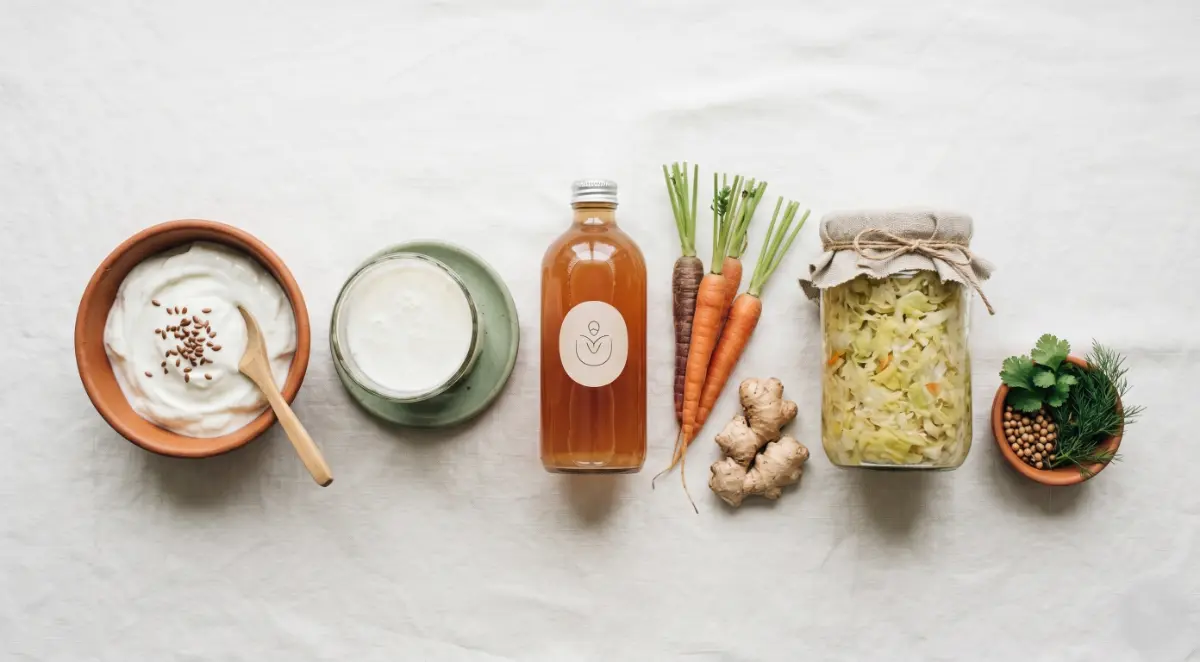
Fermented Foods: What They Are, Benefits, and How to Include Them in Your Routine
Fermented Foods: Your Microbiota's Ancestral Allies
By Vanessa Manfredini | Biomedical Scientist and Future Nutritionist
Kefir, kombucha, natural yogurt, kimchi... these names are increasingly present in health conversations. And it's not just a passing fad! Fermented foods have been used for thousands of years by different cultures, and modern science is confirming what ancestral wisdom already knew: they are very good for our gut.
Since gut health is my great passion, this is a topic I love to explain! So today I'm going to tell you everything about fermented foods: what they are, why they are good for you, the main types, and how to easily include them in your routine. Come with me! 🌿
"Fermented foods are a gift from nature to your microbiota. Good, live bacteria, ready to strengthen your gut."
What are fermented foods?
Fermented foods are those that undergo a natural process called fermentation, in which microorganisms like bacteria and yeasts transform the food. They "digest" part of the sugars and other components, creating new substances and, most importantly, beneficial live microorganisms.
That's why many fermented foods are considered probiotic foods, meaning natural sources of good bacteria that help balance our gut microbiota. Interestingly, fermentation emerged millennia ago as a way to preserve food, and only later did we discover all these health benefits!
Probiotics and Prebiotics: What's the Difference?
Before we continue, let me clarify two terms that confuse many people:
| Term | What it is | Examples |
|---|---|---|
| Probiotics | The good bacteria themselves, live microorganisms | Kefir, yogurt, kombucha, kimchi |
| Prebiotics | The food that nourishes good bacteria (fibers!) | Oats, banana, garlic, onion |
The Benefits of Fermented Foods
Fermented foods offer advantages that go far beyond digestion:
- Balance the microbiota: provide good bacteria that help keep the gut in harmony
- Improve digestion: as they are already "pre-digested" by fermentation, they save your body work
- Increase nutrient absorption: fermentation improves the availability of vitamins and minerals
- Strengthen immunity: a good part of our immunity is in the gut
- May help with mood: through the gut-brain axis, a healthy gut reflects in well-being
- Aid in cholesterol and inflammation: studies suggest positive effects
The Main Fermented Foods (and their Highlights)
🥛 Kefir
It's one of the stars! A fermented drink made from kefir grains (colonies of bacteria and yeasts) cultivated in milk or in water with sugar. It has a slightly acidic and effervescent taste, similar to a liquid yogurt. It is very rich in probiotics, potentially containing dozens of different strains of beneficial bacteria, in addition to calcium and B-complex vitamins.
🍵 Kombucha
A fermented drink made from sweetened tea, using a culture of bacteria and yeasts (the famous "scoby"). It is a source of B-complex vitamins, aids digestion, and has that slightly acidic and carbonated taste. A great option to replace sodas!
🥬 Kimchi and other fermented vegetables
Kimchi is a Korean dish of fermented vegetables (usually napa cabbage and seasonings). Along with sauerkraut (fermented cabbage), they are sources of probiotics and fiber at the same time. A powerful combo!
🥛 Natural Yogurt
The most accessible of all! Real natural yogurt (without sugar and additives) is a source of probiotics and protein. Be careful to choose natural ones, not those sweetened and full of additives.
How to Include Fermented Foods in Your Routine (Without Mistakes)
Including fermented foods is easy, but there are some important precautions to avoid discomfort:
- Start small: a small portion per day (like half a cup of kefir or a little yogurt) and gradually increase
- Observe your body: initially, some people experience gas as their gut adapts, which is normal
- Vary types: alternate between fermented foods to diversify bacteria
- Combine with fibers: pair with oats, fruits, or vegetables to enhance the effects
- Prefer natural ones: avoid industrialized fermented foods full of sugar and additives
Can I Make Them at Home?
Yes, you can, and it's delicious! Kefir, for example, is super economical: you get the grains (often donated by others), put them in milk or water with sugar, let them ferment for about 24 hours in a closed place, then strain, and it's ready to consume. The grains multiply, so it lasts forever!
Making fermented foods at home is an inexpensive and powerful way to care for your microbiota. It's just important to maintain utensil hygiene and use appropriate containers (glass, with a non-metallic strainer). 🌿
In Summary
Fermented foods are ancestral and scientifically proven allies for our gut health. They bring good bacteria, improve digestion, strengthen immunity, and even communicate with our mood through the gut-brain axis.
The secret is to include them gradually, vary the types, and combine them with fibers. Along with a balanced diet, fermented foods are a simple, economical, and delicious way to care for your inner garden. Your microbiota will thank you! 🌿
"Caring for your gut is caring for your whole self. And fermented foods are one of the oldest and wisest paths to achieve this."
Did you enjoy learning about the power of fermented foods?
Tell me in the comments: do you already consume any fermented foods? Do you want to make kefir at home? I love bringing real science about the gut, which is my passion!
With care and science, Vanessa 🌹
📚 Scientific References
This content is based on scientific studies on fermented foods and microbiota. Main references:
- Marco ML, et al. Health benefits of fermented foods: microbiota and beyond. Current Opinion in Biotechnology, 2017.
- Dimidi E, et al. Fermented foods: definitions and characteristics, impact on the gut microbiota and effects on gastrointestinal health and disease. Nutrients, 2019.
- Wastyk HC, et al. Gut-microbiota-targeted diets modulate human immune status. Cell, 2021.
- da Anunciação TA, et al. Biological significance of probiotic microorganisms from kefir and kombucha: a review. Microorganisms, 2024.
The information is for educational purposes and does not replace individualized professional guidance. Science is constantly evolving.