Berberine: what science really says about this natural compound
Berberine: what science really says about this natural compound
By Vanessa Manfredini | Biomedical Scientist and future Nutritionist
You've probably heard of berberine, perhaps as the "natural metformin" or as the substance that promises to help you lose weight and balance blood sugar. And when a compound becomes trendy, that's exactly when we need to be careful and look at what science really says.
So come with me, because today I'm going to explain simply and honestly what berberine is, what it's really for, and especially the precautions that no one usually talks about. No hype, no miraculous promises, just science with balance. 🌿
"Not everything natural is harmless, and not everything trendy works for everyone. The secret lies in understanding your body."
What is berberine?
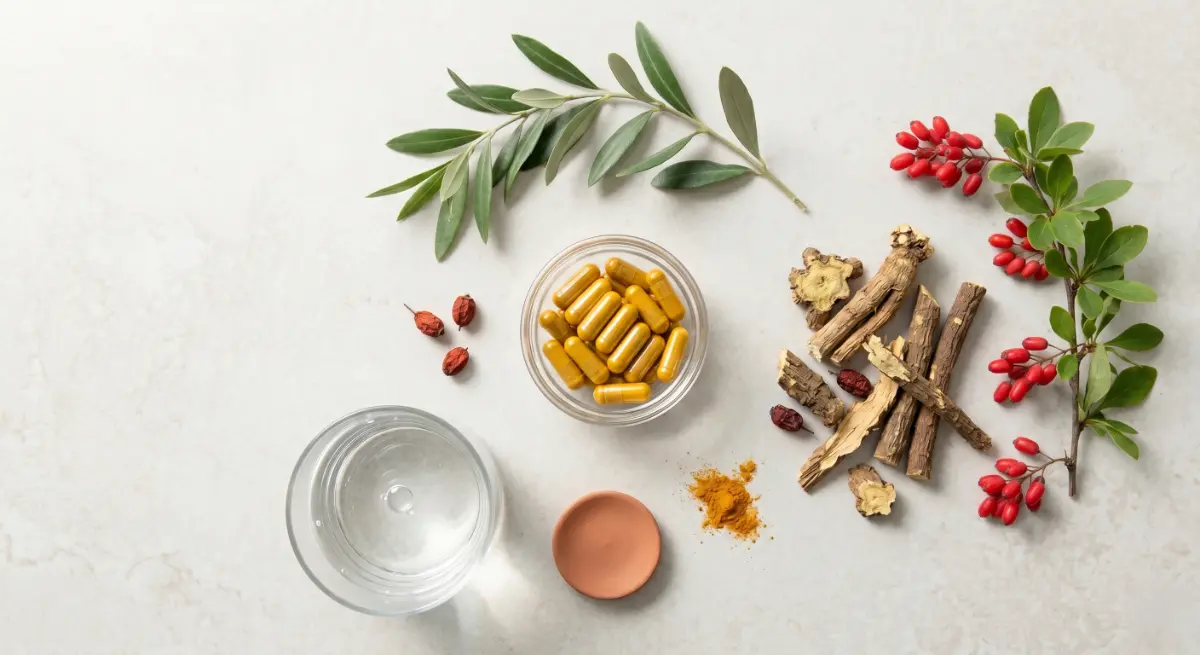
Berberine is a bioactive compound extracted from various plants, such as the Berberis, used for centuries in traditional Chinese medicine and other traditions. It has a very characteristic yellow color and a quite bitter taste.
It has gained prominence in recent years because several studies have observed interesting effects on metabolism, especially in glucose control. This led to the nickname "natural metformin." But calm down, this comparison has important limits, and I'll explain why.
How berberine acts in the body
Berberine's main mechanism involves activating an enzyme called AMPK. Think of it as your cells' energy sensor, a kind of master switch for metabolism.
When AMPK is activated, the body starts to use energy more efficiently, improves glucose utilization, and promotes fat burning. It's curious because this is the same pathway that physical exercise and fasting naturally activate. Berberine seems to turn on this switch in a biochemical way.
What berberine really works for
1. Glucose control and insulin resistance
This is the most studied effect. Research suggests that berberine can help reduce blood glucose and improve insulin sensitivity, with results that have garnered significant attention from the scientific community.
2. Cholesterol and triglyceride profile
Some studies indicate that berberine can contribute to reducing LDL cholesterol and triglycerides, aiding cardiovascular health.
3. Polycystic ovary syndrome (PCOS)
Since PCOS is strongly linked to insulin resistance, berberine has been studied in this context. Evidence suggests improvement in metabolic markers in women with PCOS. This is a topic that directly relates to women's health, which I love to discuss here.
4. Gut microbiota
Here lies my passion! Berberine seems to modulate the gut microbiota, with a selective action on certain bacteria. Since the gut communicates with metabolism all the time, this could be one of the pathways through which it acts. It's still an area under study, but very promising.
The famous comparison with metformin
Calling berberine "natural metformin" is a simplification that can be dangerous. Despite some similarities in metabolic effects observed in studies, they are different things.
The precautions no one talks about
| Attention | Why |
|---|---|
| Not for everyone | Pregnant women, nursing mothers, and babies should not use |
| Drug interactions | May interact with medications, especially for diabetes and blood pressure |
| Digestive effects | May cause discomfort, diarrhea, or constipation, especially at the beginning |
| Short half-life | Usually divided into doses throughout the day |
| Variable quality | The supplement market is poorly regulated, origin matters a lot |
After all, does berberine work or is it just a trend?
I'll be very direct with you, because I know this is the lingering doubt: yes, berberine really works, it's not just a trend. What exists is a lot of marketing exaggeration on top of something that truly has science behind it.
Does it work? Yes, especially for those with insulin resistance, pre-diabetes, or PCOS. The effects on glucose and cholesterol control are real and have been observed in several studies.
Is it a miracle? No. The weight loss effect is indirect, coming from improved metabolism, not from magical fat burning.
Is it for everyone? No. If your glucose and insulin are already balanced, it won't bring extra benefits. It shines when there's a metabolic imbalance to correct.
In other words: berberine is a tool with real scientific backing, but it works within a context. It's not the villain some say, nor the salvation that marketing promises. Balance, as always, is in the middle.
Is it worth it for you?
Berberine is a fascinating compound with interesting science behind it, especially for those with insulin resistance, PCOS, or metabolic changes. But it's not a magic solution and it's not for everyone.
Before you go buying any trendy supplement, the smartest path is to understand your body, get your tests done, and rely on professional guidance. Berberine can be one piece, but the puzzle of your health is much larger and more individual than any capsule. 🌿
📌If you want to delve deeper into topics connected with berberine, it's worth reading the posts about PCOS, about your gut microbiota, and about GLP-1 pens.
"The right supplement is one that makes sense for your body, at your moment, with your history. There is no single formula for everyone."
Did you like understanding the truth about berberine?
Tell me in the comments: had you heard of it before? Were you curious about any other trendy supplement? I love bringing real science to you, without alarmism and without hype. And follow me on social media for more content like this:
With care and science, Vanessa 🌹
📚 Scientific References
This content is based on scientific studies and evidence about berberine. Main references:
- 1. Yin J, Xing H, Ye J. Efficacy of berberine in patients with type 2 diabetes mellitus. Metabolism, 2008.
- 2. Dong H, et al. Berberine in the treatment of type 2 diabetes mellitus: a systematic review and meta-analysis. Evidence-Based Complementary and Alternative Medicine, 2012.
- 3. Lee YS, et al. Berberine, a natural plant product, activates AMP-activated protein kinase. Diabetes, 2006.
- 4. Zhang Y, et al. Treatment of type 2 diabetes and dyslipidemia with the natural plant alkaloid berberine. The Journal of Clinical Endocrinology & Metabolism, 2008.