Hashimoto and Diet: what to eat and what to avoid in autoimmune thyroiditis
By Vanessa Manfredini | Biomedical Scientist and future Nutritionist
Persistent fatigue even after sleeping. Alarming hair loss. Dry skin, brittle nails, weight gain without changes in diet. Failing memory, fluctuating mood, constant cold even when it's warm.
If you recognize yourself in any of these symptoms, you are not alone, and it may not be a lack of energy or excessive stress. It could be your thyroid asking for help.
Hashimoto's thyroiditis is the most common cause of hypothyroidism worldwide, and it affects women in a much higher proportion than men. It is an autoimmune disease where the immune system attacks the thyroid gland itself, and it has a much deeper relationship with the gut and diet than conventional medicine usually recognizes.
Today I will explain what Hashimoto's is, how it affects your body, and what diet can do to reduce inflammation and support your thyroid health.
"Hashimoto's has no cure but it has management. And diet is one of the most powerful tools for this management."
What is Hashimoto's thyroiditis?
Hashimoto's thyroiditis, or chronic lymphocytic thyroiditis, is an autoimmune disease in which the immune system produces antibodies that attack the thyroid, the gland located in the neck responsible for producing hormones that regulate almost everything in metabolism: body temperature, heart rate, digestion, mood, hair, skin, menstrual cycle, and much more.
With continuous immune attack, the thyroid is progressively destroyed and loses the ability to produce enough hormones, leading to hypothyroidism.
The two most important antibodies in diagnosis are:
- Anti-TPO (anti-thyroid peroxidase antibody) - the most sensitive for Hashimoto's
- Anti-Tg (anti-thyroglobulin antibody) - complements the diagnosis
Diagnosis is confirmed with blood tests for TSH, free T4, Anti-TPO, and Anti-Tg, and ideally with a thyroid ultrasound. If you have symptoms and haven't had these tests yet, talk to your doctor.
Why is Hashimoto's so much more common in women?
About 90% of Hashimoto's cases occur in women. This is no coincidence; it has to do with female biology:
- Estrogen modulates the immune system in a way that favors autoimmune responses
- Hormonal variations throughout the menstrual cycle, during pregnancy, and in menopause can trigger or worsen the condition
- Genetic predisposition is real; if your mother or grandmother has thyroid issues, the risk is higher
- Chronic stress, very present in women's routines, is one of the main autoimmune triggers
The connection between Hashimoto's and the gut
Here enters my perspective as a Biomedical Scientist and one of the points I consider most important and most ignored in Hashimoto's care:
There is a deep and bidirectional connection between gut health and thyroid autoimmunity. Studies show that:
- People with Hashimoto's have a higher prevalence of gut dysbiosis and leaky gut
- Intestinal hyperpermeability allows particles to cross the barrier and activate the immune system, potentially directing the autoimmune attack to the thyroid
- Celiac disease, also autoimmune and intestinal, has a proven association with Hashimoto's. People with Hashimoto's have an increased risk of gluten sensitivity
- Caring for the microbiota can reduce inflammatory activity and, in some cases, contribute to the reduction of antibodies
This does not mean that healing the gut will cure Hashimoto's. But it does mean that ignoring the gut while treating the thyroid is missing a fundamental piece of the puzzle.
"The gut and the thyroid communicate. A healthy microbiota can be a powerful ally in controlling Hashimoto's."
Hashimoto's Symptoms: what to observe
Symptoms vary greatly from person to person and can be subtle at first:
Most common symptoms
- Persistent fatigue - even with good sleep, tiredness doesn't go away
- Weight gain without changes in diet
- Hair loss - especially on the outer edges of the eyebrows
- Dry, cold, and dull skin
- Chronic constipation
- Constant feeling of cold
- Bradycardia - slow heart rate
- Depression, brain fog, and difficulty concentrating
- Irregular menstrual cycle or increased flow
- Hoarseness and feeling of a tight throat
Less common symptoms
- Muscle and joint pain without apparent cause
- Swelling, especially in the face, eyelids, and ankles
- Reduced libido
- Difficulty getting pregnant or maintaining pregnancy
- Elevated cholesterol - the thyroid participates in cholesterol metabolism
What to eat for Hashimoto's: essential nutrients
Diet does not directly treat Hashimoto's, but it can reduce inflammation, support thyroid function, and greatly improve quality of life. See the most important nutrients:
Selenium: the most studied mineral in Hashimoto's
Selenium is an essential cofactor for enzymes that activate thyroid hormones and has an antioxidant action that protects the thyroid from immune attack. Studies show that selenium supplementation can reduce Anti-TPO levels in people with Hashimoto's.
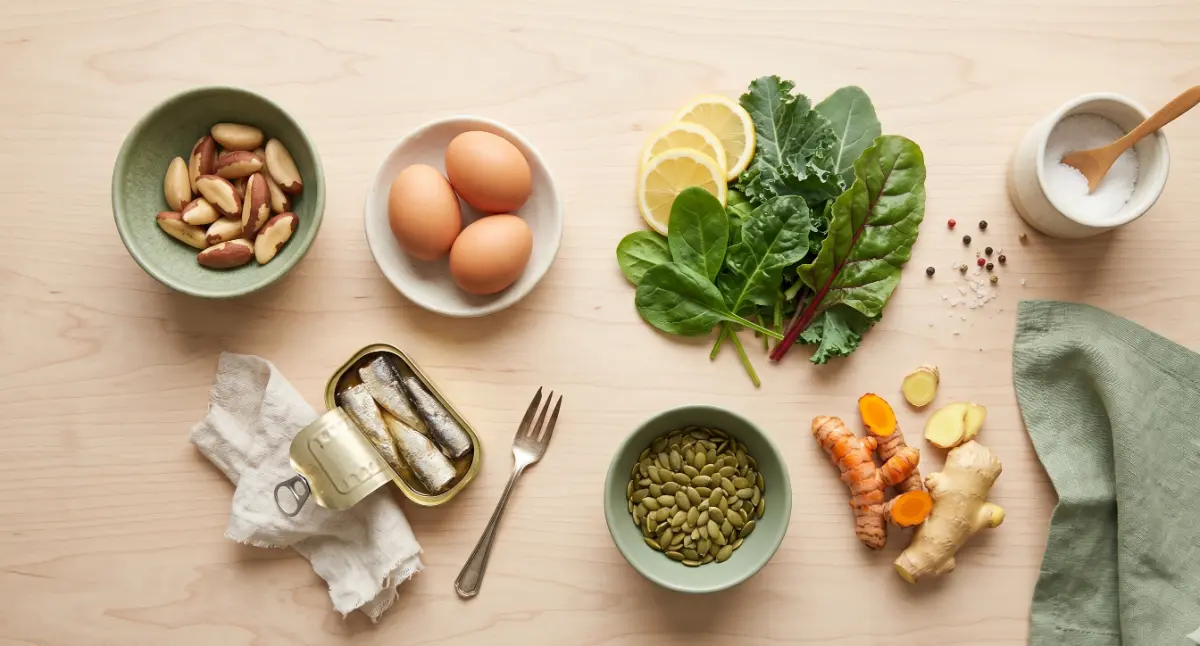
- Brazil nuts: 1 to 2 units per day already meet the daily requirement - it's the richest source in the world!
- Seafood, tuna, sardines, eggs, and meats are also good sources
Zinc: essential for thyroid hormone conversion
Zinc participates in the conversion of T4 to T3, the active form of thyroid hormone. Zinc deficiency can worsen hypothyroidism even with adequate medication.
- Lean red meat, chicken, eggs
- Pumpkin seeds: one of the richest plant sources
- Nuts, legumes, chickpeas
Vitamin D: the hormone the body doesn't produce on its own
Vitamin D deficiency is extremely common in people with autoimmune diseases, including Hashimoto's. It regulates the immune system, and its deficiency can increase autoimmune activity.
- The main source is sun exposure: 15 to 20 minutes of sun per day
- Foods: fatty fish like sardines and salmon, egg yolk, sun-exposed mushrooms
- Supplementation is often necessary, always with medical guidance and based on tests
Omega-3: direct anti-inflammatory action
Omega-3 reduces the production of inflammatory cytokines that fuel the autoimmune process. It is one of the supplements with the strongest scientific basis for autoimmune diseases.
- Sardines, tuna, and salmon: consume at least twice a week
- Chia and flax seeds: plant sources of omega-3
- Fish oil supplementation may be indicated; consult a professional
Iron: often deficient in Hashimoto's
Hypothyroidism reduces intestinal iron absorption, and iron deficiency, in turn, worsens thyroid function – it's a cycle that needs to be broken. Women with Hashimoto's should regularly monitor iron stores (ferritin).
- Lean red meats: the most bioavailable source of heme iron
- Beans, lentils, dark leafy greens: non-heme iron, better absorbed with vitamin C
- Combine with orange, acerola, or lemon to enhance absorption
What to avoid or reduce in Hashimoto's
Gluten: a controversial but relevant relationship
This is one of the most debated topics in Hashimoto's. A gluten-free diet is not indicated for all people with Hashimoto's, but for those with concomitant celiac disease or non-celiac gluten sensitivity, its removal can reduce antibodies and greatly improve symptoms.
What science suggests: if you have Hashimoto's, it's worth getting tested for celiac disease antibodies. If positive, a gluten-free diet is essential. If negative, removal can be tested for 3 to 6 months with nutritional guidance to assess individual response.
Ultra-processed foods and refined sugar
They fuel chronic inflammation that sustains the autoimmune process. Reducing these foods is one of the most important pillars, regardless of any other restriction.
Goitrogens in excess: with caution
Broccoli, kale, cabbage, and other raw cruciferous vegetables contain substances called goitrogens that, in excess, can interfere with thyroid hormone production. But beware: cooking greatly reduces this effect, and these foods have enormous benefits for gut and immune health. No need to eliminate them; avoid consuming them raw in large quantities and always prefer them cooked.
Soy in excess
Soy contains isoflavones that can interfere with levothyroxine absorption and thyroid function in people with Hashimoto's. Consume in moderation, and if you are on medication, avoid consuming soy close to the medication time.
Caring for the gut as an anti-inflammatory strategy
As we've seen, the connection between the gut and Hashimoto's is real and important. Include in your routine:
- Fermented foods - kefir, natural yogurt, curd, sauerkraut
- Prebiotic fibers - beans, oats, green banana, garlic, onion
- Vegetable variety - at least 20 different types of plant foods per week
- Reduce ultra-processed foods and alcohol - which compromise the intestinal barrier
These strategies do not directly treat Hashimoto's, but they create a less inflammatory gut environment, which can contribute to lower autoimmune activity over time.
Conclusion
Hashimoto's is a serious condition that requires medical supervision; that doesn't change. But diet is a powerful support tool that goes far beyond what most people imagine.
Caring for the gut, ensuring essential nutrients for the thyroid, reducing chronic inflammation, and understanding how your body responds to different foods – all of this is part of comprehensive and individualized care.
If you have Hashimoto's or suspect you might have it, seek an endocrinologist for diagnosis and medical treatment, and consider including specialized nutritional guidance in your journey. You deserve comprehensive care.
"Hashimoto's doesn't define you. But understanding how it works empowers you to take better care of your body."
Did you like this content?
Leave your comment below: do you have or suspect you have Hashimoto's? Do you have any questions about diet and thyroid? Let me know! And follow me on Instagram @vanessamanfredini.nutri for more scientific content on women's health and metabolism! 🌿
With care and science, Vanessa 🌹
Learn more about Female Metabolism, at this link.
This content is based on scientific studies about Hashimoto's thyroiditis. Main references:
- 1. Caturegli P, et al. Hashimoto thyroiditis: clinical and diagnostic criteria. Autoimmunity Reviews, 2014.
- 2. Ralli M, et al. Hashimoto's thyroiditis: an update on pathogenic mechanisms. Autoimmunity Reviews, 2020.
- 3. Liontiris MI, Mazokopakis EE. A concise review of Hashimoto thyroiditis and the importance of iodine, selenium, vitamin D and gluten. Hellenic Journal of Nuclear Medicine, 2017.